Gaspar García, CFD portfolio
Tandem Ahmed bodies: steady RANS follows the drag trend, not the close-gap values
CaveatedUpdated 2026-11-14
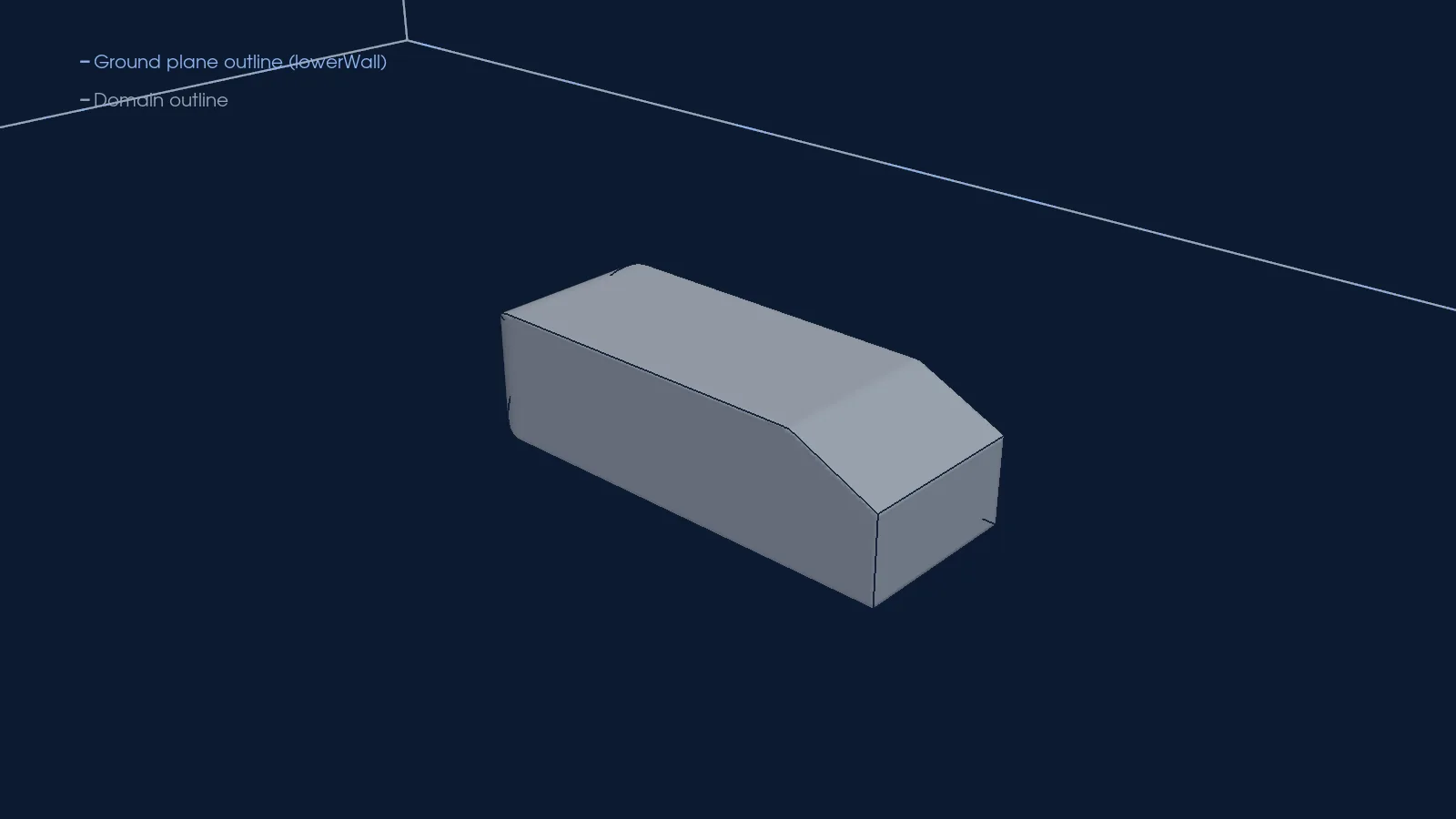
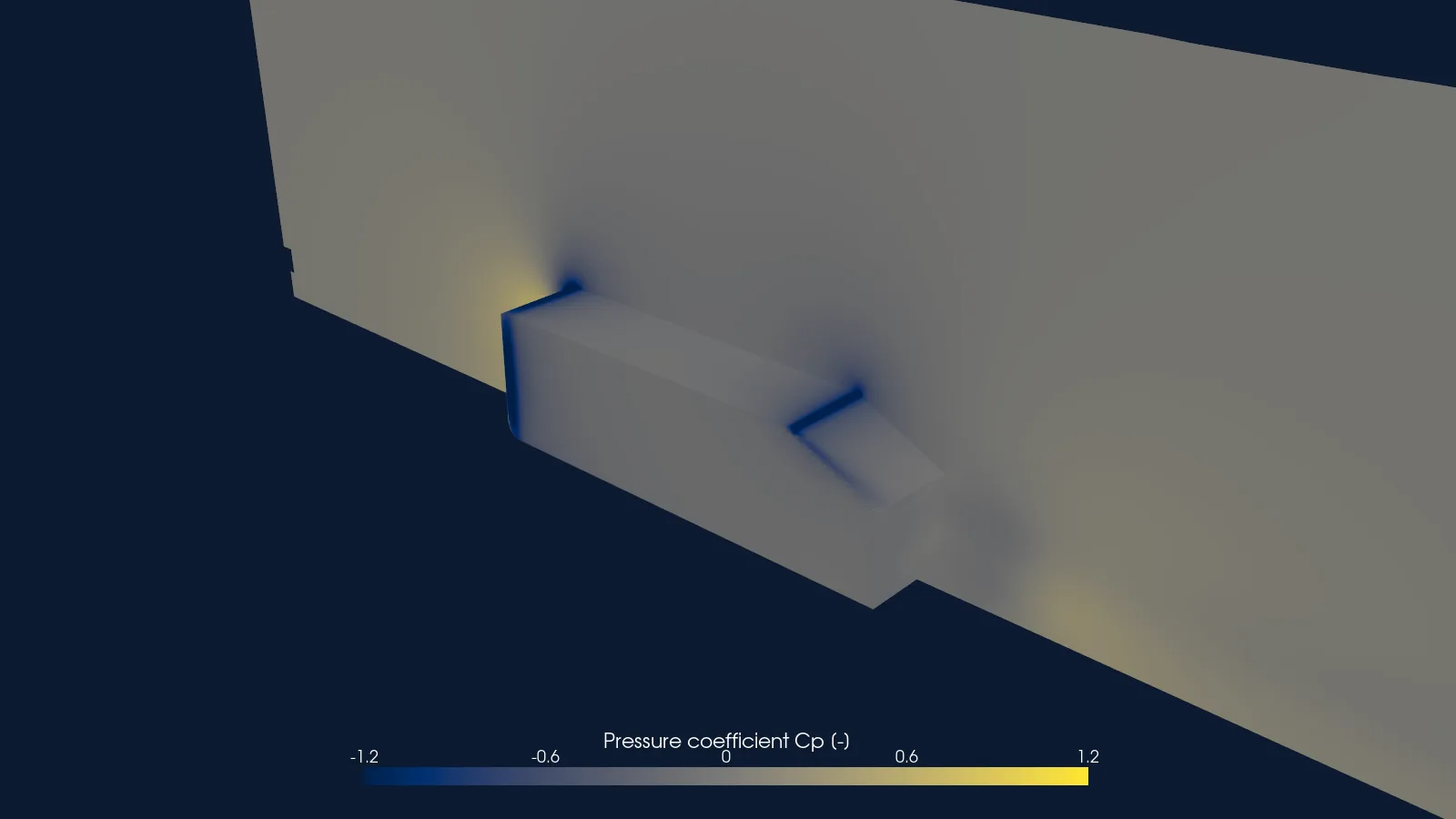
Objective. Compute the drag of a 75 %-scale Ahmed body (25° slant) alone and in a two-car line at eight gaps with steady RANS, and compare the drag-ratio trend with wind-tunnel data.
| Reynolds number (free-stream speed, body length) | 1.8 × 10⁶ |
|---|---|
| Free-stream speed | 34.48276 m/s |
| Body length (75 % of the Ahmed body) | 0.783 m |
| Reference area (frontal) | 0.063018 m² |
| Ground clearance | 37.5 mm |
| Fluid | Incompressible air, kinematic viscosity 1.5e-05 m²/s (assumed air at about 20 °C) |
| Solver | OpenFOAM v2412, simpleFoam (steady, SIMPLEC) |
| Turbulence model | k-omega SST |
Comparison with experiment
| Quantity | Experiment | Simulation | Signed difference |
|---|---|---|---|
| Isolated Cd, against Pagliarella 2009 (Table 4.1, same Reynolds number) | 0.30 | 0.2798 | −6.7 % |
| Isolated Cd, against Meile 2011 (full scale) | 0.299 | 0.2798 | −6.4 % |
| Lead ratio, x/L 0.375 (late window) | 0.469 | 0.338 | −28.0 % |
| Lead ratio, x/L 0.5 (start-dependent, see below) | 0.628 | 0.555 | −12 % |
Lead C_D / C_D,isolated against Gap x/L from the lead-body base
- Experiment (Pagliarella 2009, Fig. 4.1a, digitised)
- Simulation, k-omega SST (bars: iterative scatter)
Verdict
The isolated Cd is 0.2798, 6 to 7 % below two experimental values, on one mesh with no numerical uncertainty. The tandem trend is reproduced, but the lead body is 12 to 28 % low at close gaps and the one grid ladder did not converge: a comparison, not a validation.
Limits
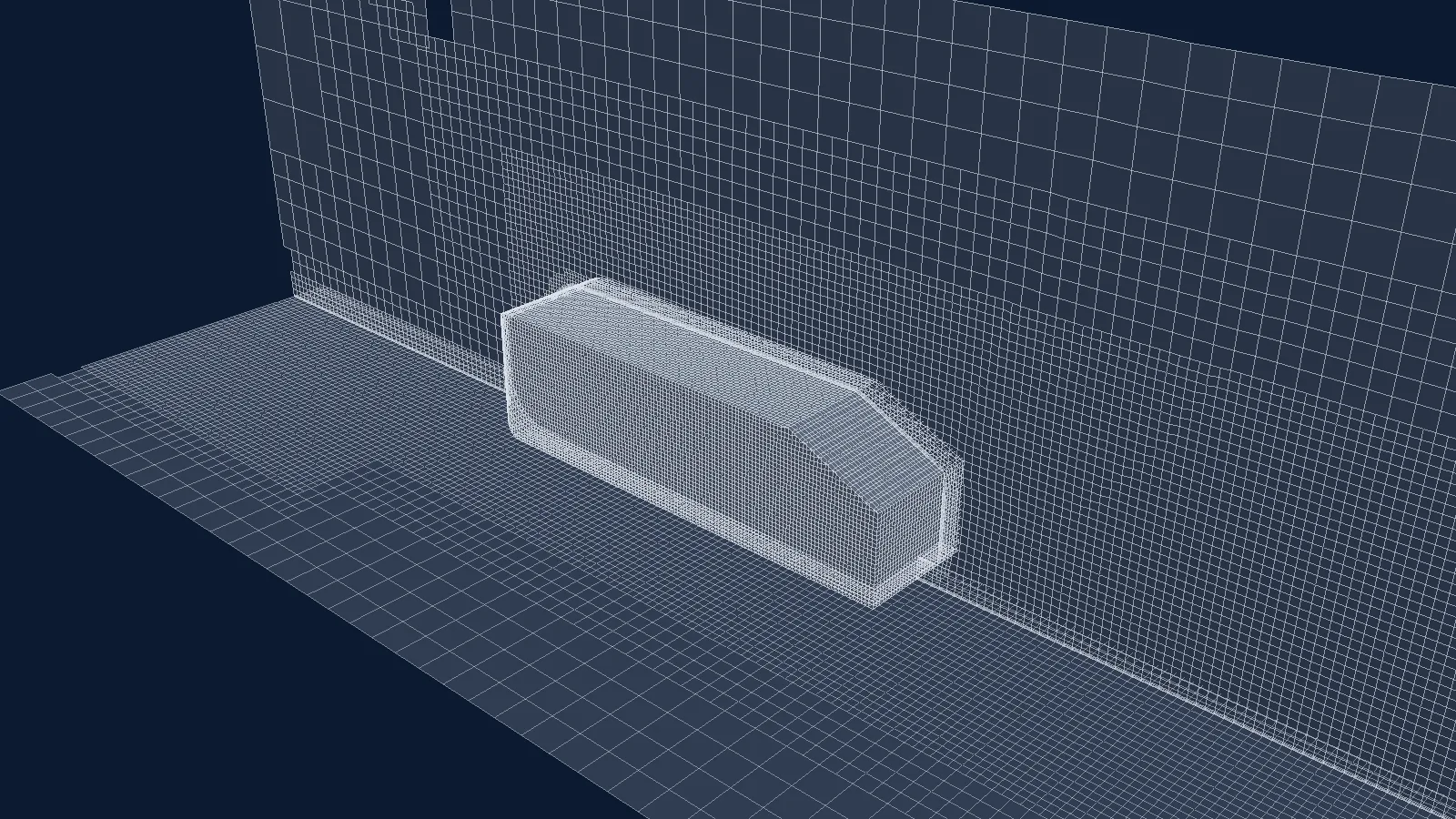
- One mesh per case; the four-grid ladder at x/L 0.5 did not converge, so no band is given anywhere.
- Bars on the simulation are iterative scatter; the x/L 0.5 lead ratio ranges over 0.495 to 0.557 with start and mesh.
- Extended checkMesh fails three checks on every mesh; stings and wall boundary layers not modelled.