Gaspar García, CFD portfolio
Tall-cavity natural convection: mean Nusselt number 20 % below the quoted experiment, and refining the grid does not close the gap
ComparedUpdated 2026-11-14
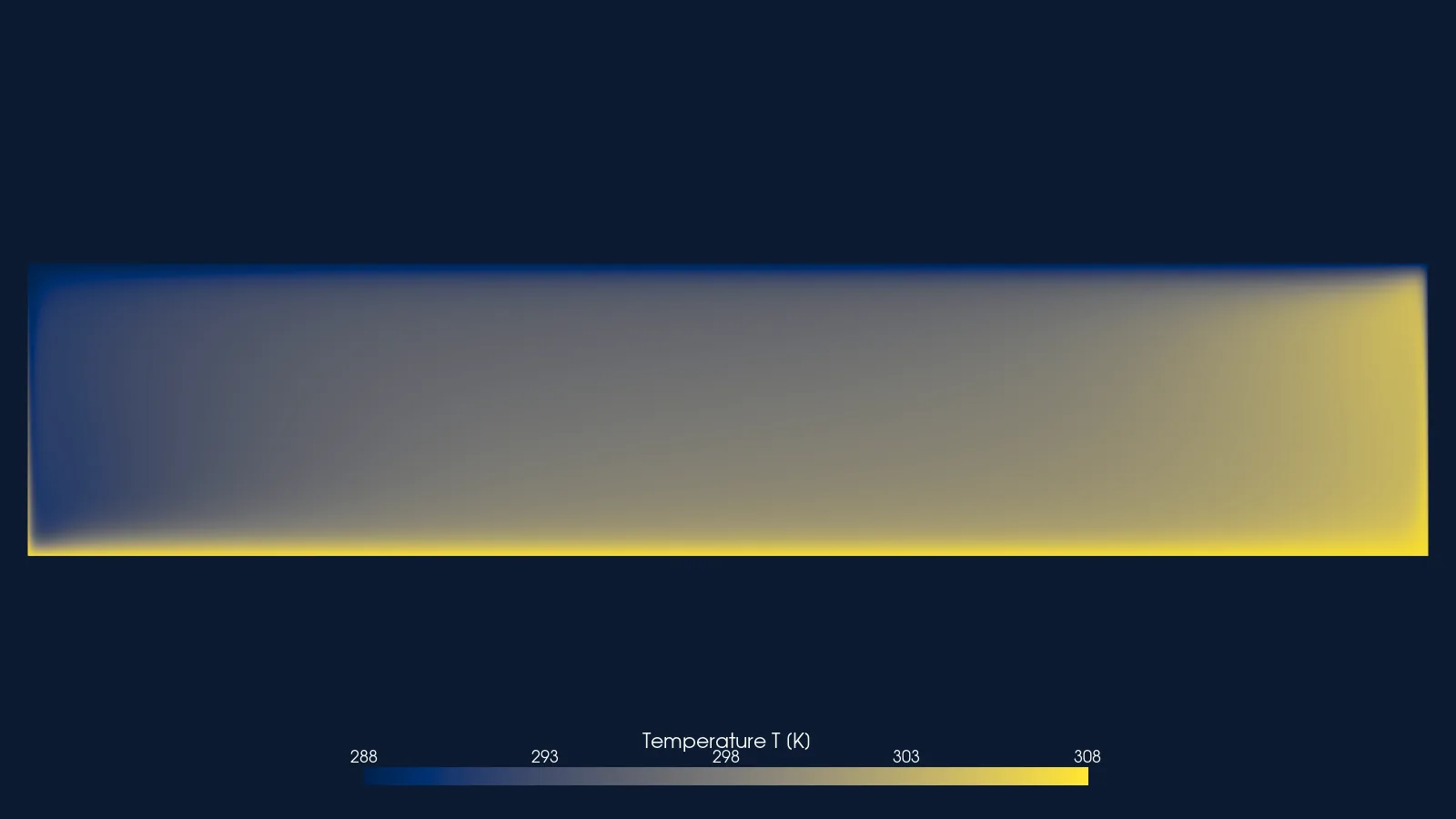
Objective. Predict buoyancy-driven heat transfer in a tall air cavity heated on one side and cooled on the other, with a measured numerical uncertainty, and compare it with the Betts and Bokhari experiment.
| Rayleigh number (cavity width) | 0.86 × 10⁶ |
|---|---|
| Height, width, depth | 2.18 m, 0.076 m, 0.52 m |
| Wall temperatures | 307.75 K and 288.15 K (19.6 K) |
| Fluid | Air, Pr 0.705 |
| Solver | OpenFOAM v2412, buoyantSimpleFoam |
| Turbulence model | k-omega SST, wall-resolved |
| Wall y+ max | 0.097 finest, 0.26 coarsest |
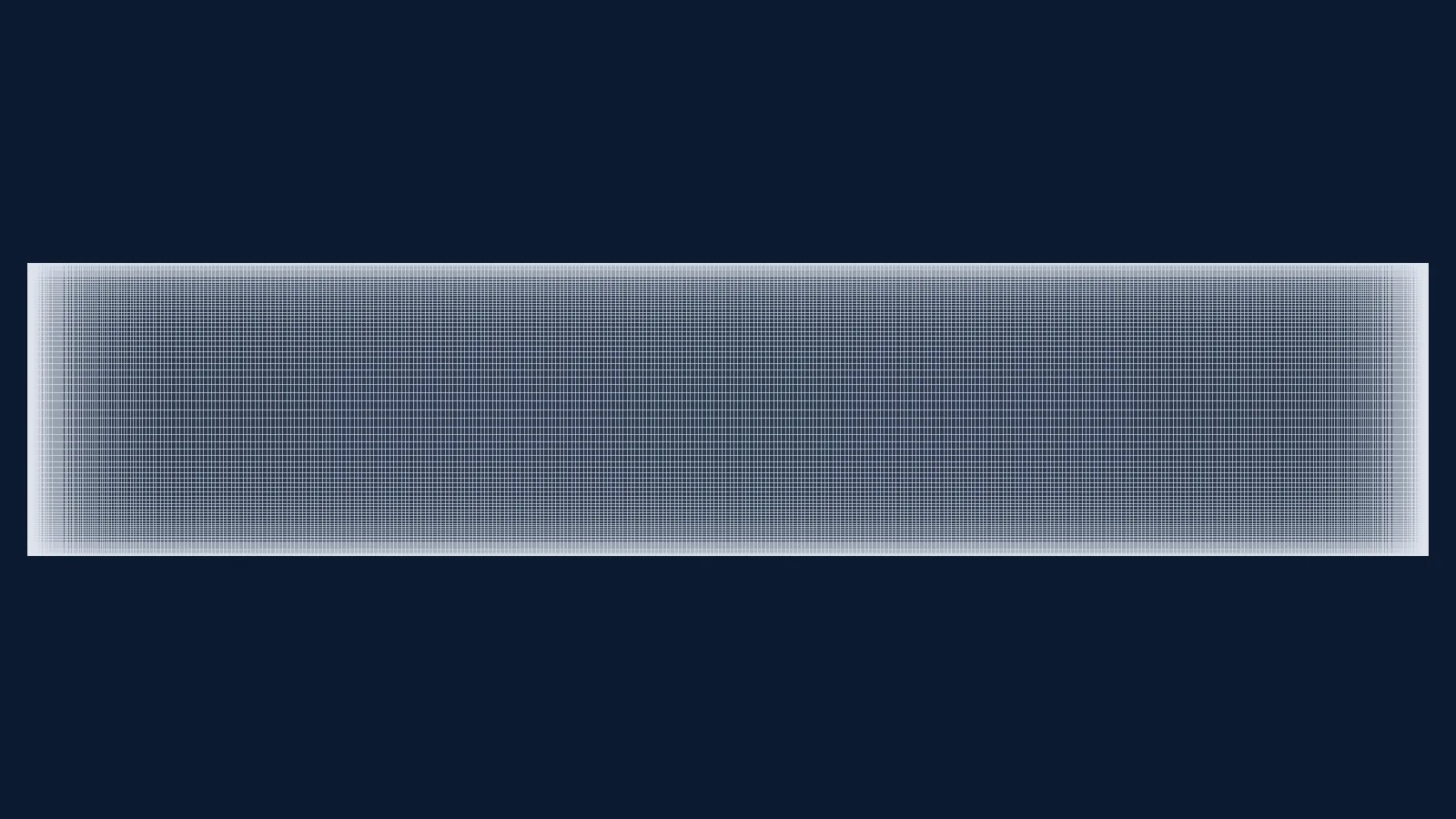
| Cells | 8,000 to 64,410 |

Comparison with experiment
| Quantity | Experiment | Simulation, finest grid | Signed difference |
|---|---|---|---|
| Mean Nusselt number | 5.85 | 4.658 | −20.4 % |
| Peak upward velocity at y/H 0.5 | 0.140 m/s | 0.1664 m/s | +19 % |
| Mean temperature, RMS difference across the cavity, 9 heights | – | – | 0.41–1.45 K |
| Temperature normal to floor / roof at x 38.1 mm, RMS difference | – | – | 0.31 K / 0.85 K |
Mean Nu against Cells
- Simulation, k-omega SST
- Least-squares extrapolation
- Experiment (quoted, KBwiki UFR 4-10)
Verdict
Wall-resolved k-omega SST on four grids gives mean Nu 4.658 ±0.025, −20.4 % from the 5.85 quoted for the experiment; the extrapolated 4.678 shows the gap is not a grid effect. Its cause (model, inputs, measurement or Nu definition) cannot be separated with the data on hand.
Limits
- The experimental Nu is second-hand, with unknown definition and uncertainty: a comparison, not a validation.
- 2-D slice of a 3-D rig; top and bottom wall temperatures imposed from the experiment.
- The wall-layer explanation is a 3-point-gradient inference; the too-laminar hypothesis is untested.