Gaspar García, CFD portfolio
Laminar cylinder wake at Re 150: the Strouhal number is within 0.84 % of a published simulation on all four grids
CaveatedUpdated 2026-11-14
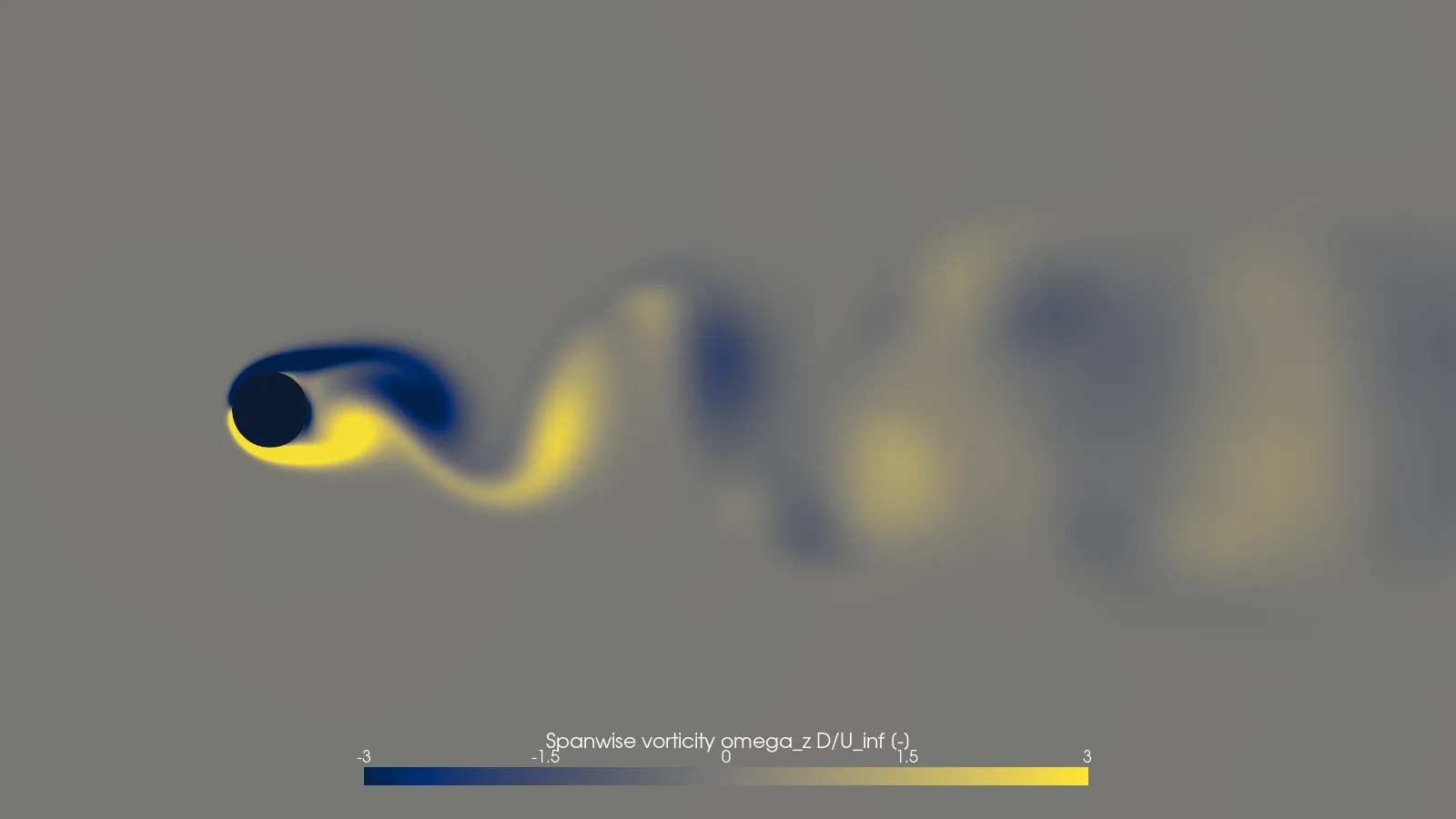
Objective. Reproduce laminar vortex shedding behind a circular cylinder at Re 150 on a four-grid ladder and compare the shedding frequency and forces with a published 2-D simulation.
| Reynolds number (free-stream speed, diameter) | 150 |
|---|---|
| Scales | Non-dimensional: D = 1, U = 1, kinematic viscosity 0.006666666667 (1/Re) |
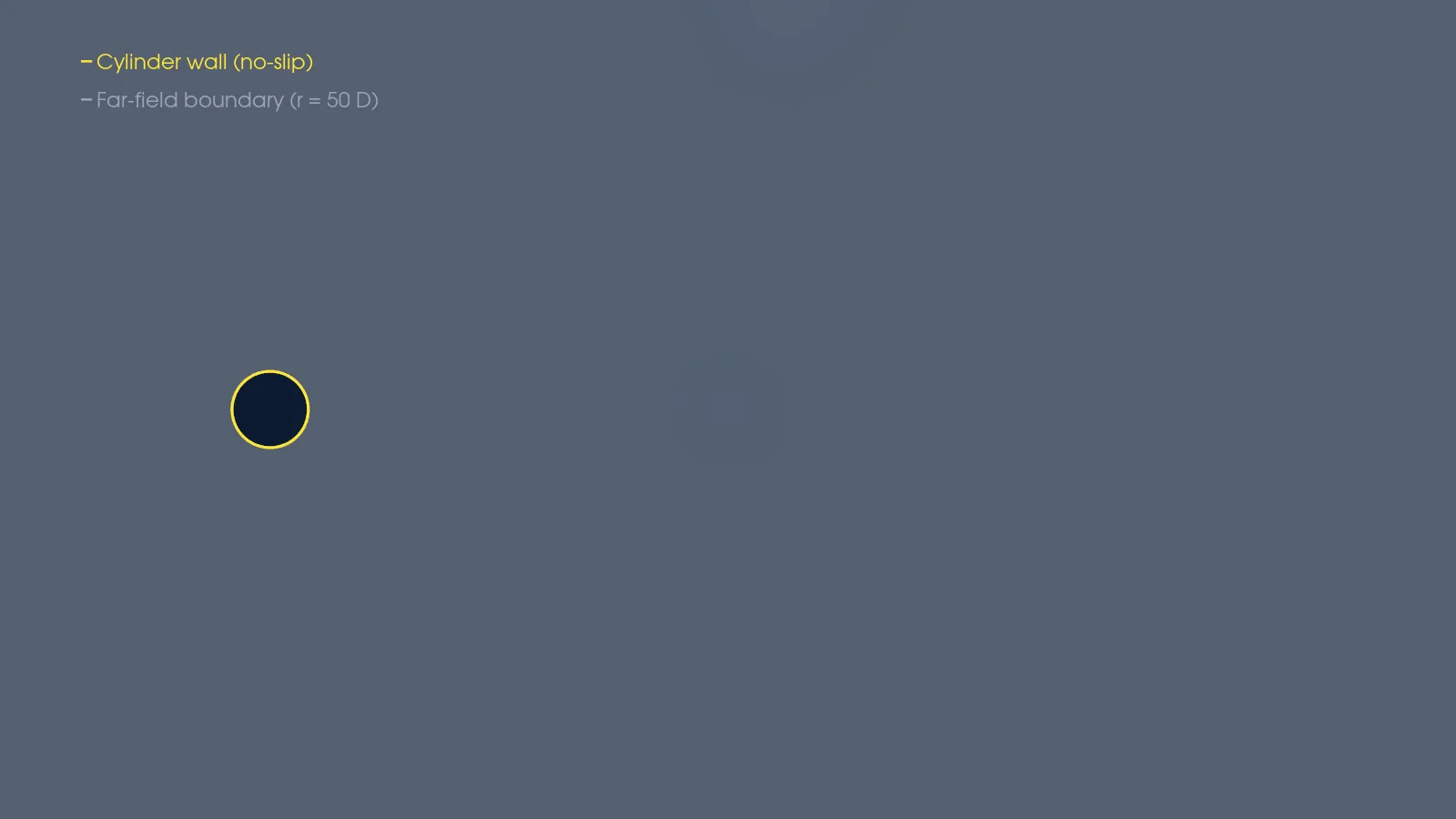
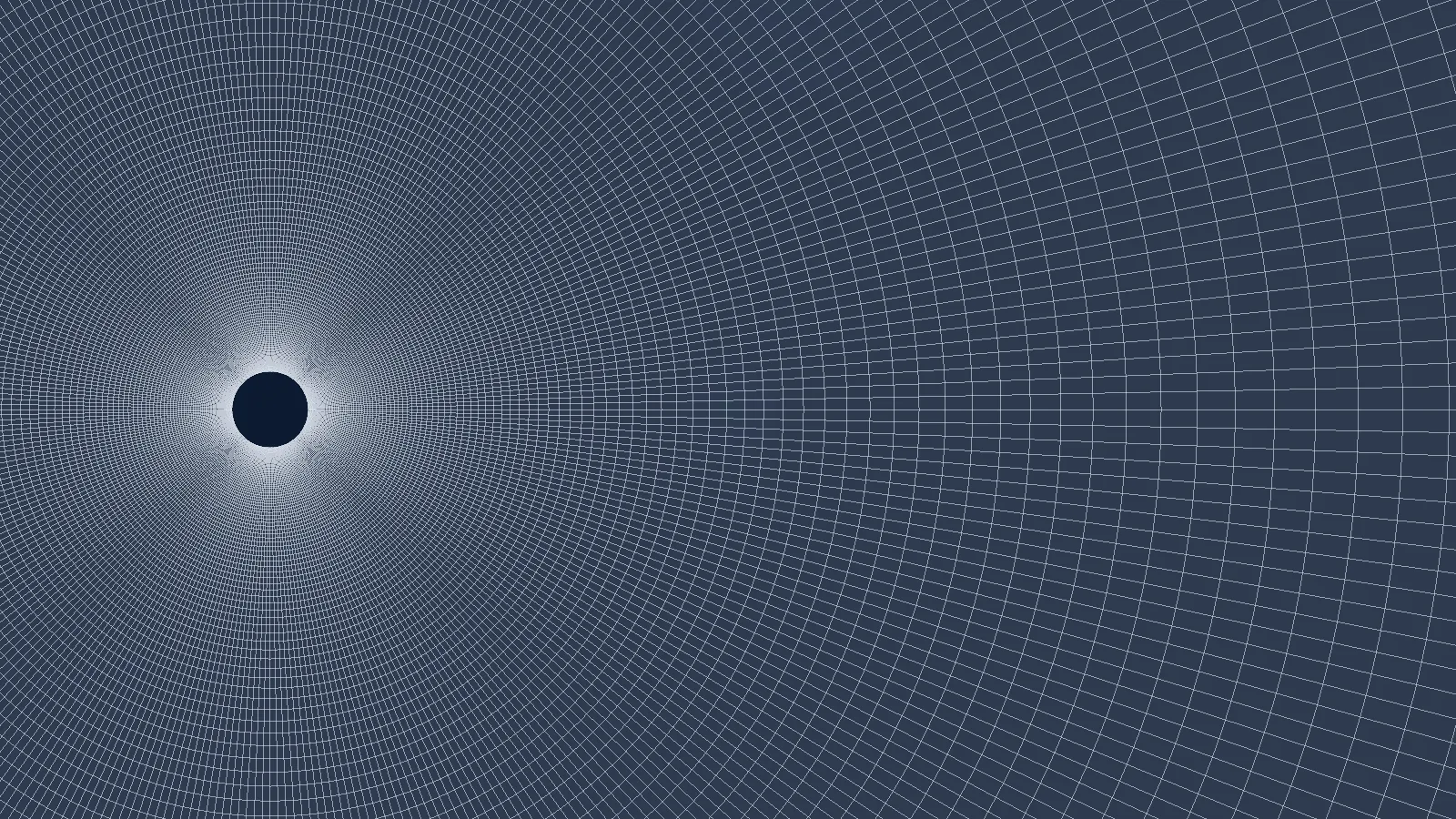
| Domain | O-grid to a radius of 50 D |
| Solver | OpenFOAM v2412, pimpleFoam (transient, incompressible) |
| Turbulence model | None: laminar |
| Wall treatment | Resolved: first radial cell 0.0067 D on the finest grid |
| Time step, finest grid | 0.005 |
| Cells | 5,600, 11,200, 22,572, 44,800 |
Comparison with the reference simulation
| Quantity | Reference (Qu et al. 2013) | Simulation, finest grid | Signed difference |
|---|---|---|---|
| Strouhal number | 0.1841 | 0.183855 | −0.13 % |
| Mean drag coefficient (non-monotone in the grid) | 1.305 | 1.32266 | +1.35 % |
| rms lift coefficient (non-monotone in the grid) | 0.3546 | 0.374123 | +5.5 % |
| rms drag coefficient (non-monotone in the grid) | 0.0173 | 0.0189802 | +9.7 % |
Strouhal number against Cells
- Simulation, pimpleFoam laminar
- Reference, Qu et al. 2013 (simulation)
Verdict
The Strouhal number is 0.1839 on the finest grid, −0.13 % from the reference and within 0.84 % on all four grids. The ladder is not monotone on the three finest grids and the forces have no defensible band, so only the frequency is claimed.
Limits
- Code-to-code: the reference is a simulation, not an experiment.
- Three-grid GCI refused for St; the least-squares band leans on the coarsest grid.
- Drag and lift fluctuations converge non-monotonically; noise level not shown (no numeric reference).