Gaspar García, CFD portfolio
Impinging jet: a transition model does not fix the stagnation region
ComparedUpdated 2026-11-14
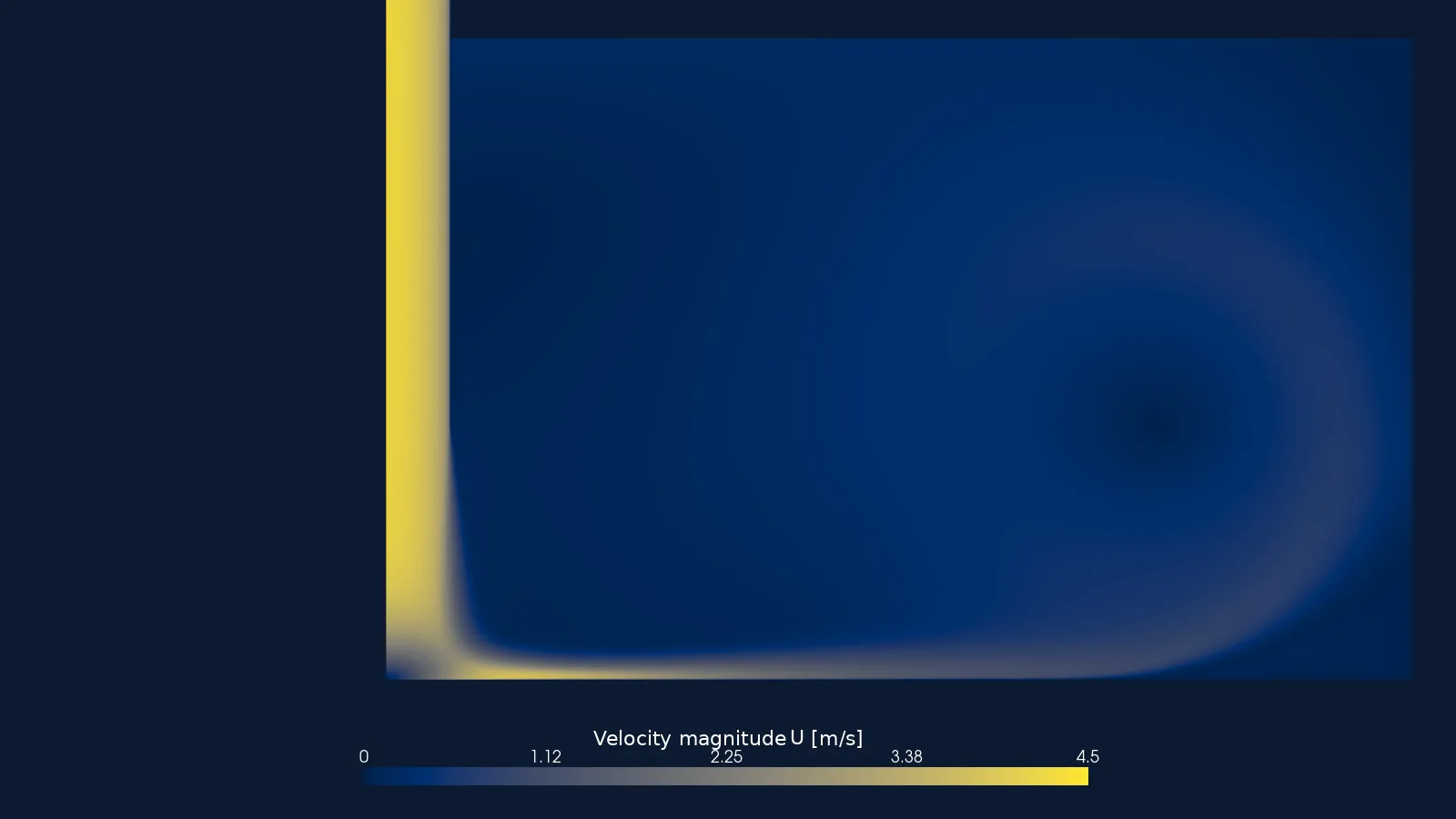
Objective. Predict wall heat transfer under a round turbulent jet impinging on a heated plate, and test whether a transition model recovers the secondary Nusselt peak that fully turbulent RANS misses.
| Reynolds number (bulk velocity, nozzle diameter) | 23,000 |
|---|---|
| Nozzle-to-plate distance H/D | 2 |
| Nozzle diameter D | 0.1016 m |
| Bulk velocity | 3.48857 m/s |
| Fluid | Air: density 1.18816 kg/m³, viscosity 1.831e-05 Pa s, Prandtl number 0.705 |
| Solver | OpenFOAM v2412, buoyantSimpleFoam with gravity off (forced convection) |
| Turbulence model | k-omega SST; Langtry-Menter k-omega SST-LM on the identical mesh |
| Wall treatment | Wall-resolved: plate first cell 20 µm, y+ max 0.23 |


Comparison with experiment
| Quantity | Experiment | SST | SST, signed | SST-LM | SST-LM, signed |
|---|---|---|---|---|---|
| Nu error at stagnation, r/D 0 | 0.1223 | 0.1384 | +13 % | 0.1419 | +16 % |
| Nu error at the secondary peak, r/D 1.94 | 0.0941 | 0.0881 | −6 % (no peak) | 0.0860 | −9 % (no peak) |
| Nu error in the wall jet, r/D 2.5 and beyond | – | – | −4.3 to +0.4 % | – | −1.5 to +4.3 % |
| Mean |error|, all stations | – | – | 12.3 % | – | 12.2 % |
Nu / Re^0.7 against r/D
- Experiment (Baughn et al. 1992)
- k-omega SST
- k-omega SST-LM
Verdict
k-omega SST gets the developed wall jet right and over-predicts stagnation heat transfer by +13 %. The transition model gives the same mean error and no secondary peak, so the simpler model stays.
Limits
- Single grid: no numerical uncertainty band.
- Experimental Nu uncertainty is not stated in the source.
- SST ran 4000 iterations against 8000 for SST-LM, so the mean-error tie is unresolved.