A small propeller: tracing a +27.8 % thrust error to the blade pitch, with power still unexplained
I lofted an 11-inch propeller from its published chord and twist table and solved one operating point with a rotating-frame RANS model. Thrust and power both came out +27.8 % and +27.1 % high, which pointed to the pitch, not the physics. Re-pitching the blade to its nominal value removed the thrust error but left power +11.6 % high, and I do not know why. This page is the diagnosis, not an accuracy claim.
- Thrust coefficient CT, simulation
- 0.01558
- UIUC 0.0156; signed difference −0.11 %, not a precision figure (see below)
- Power coefficient CP, simulation
- 0.01696
- UIUC 0.0152; signed difference +11.6 %, unexplained
- Signed differences
- CT −0.11 %, CP +11.6 %
- at J 0.523, 1 % in J moves CT by 5.4 %
- Numerical uncertainty
- none: single grid
2Geometry, mesh, results
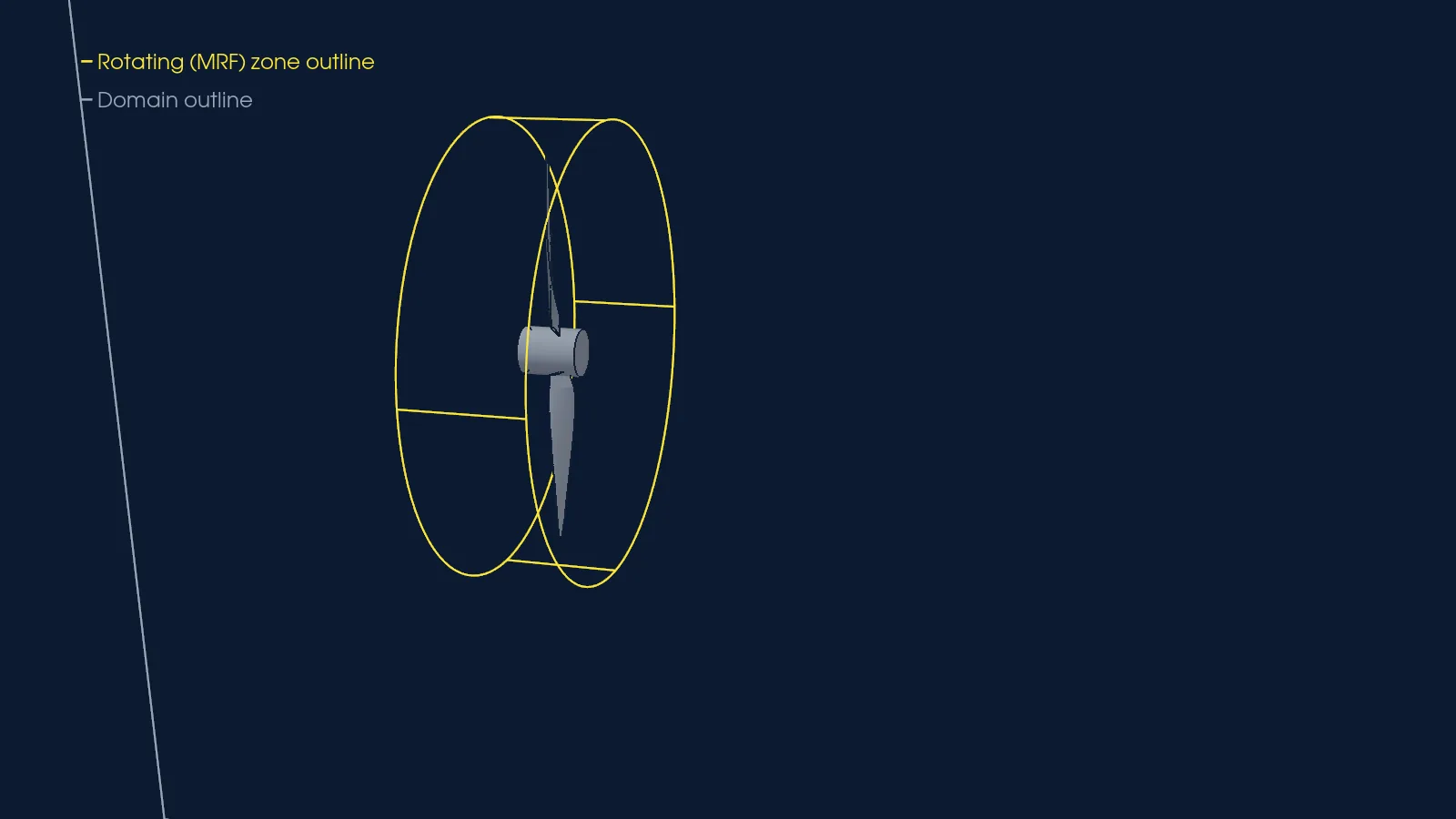
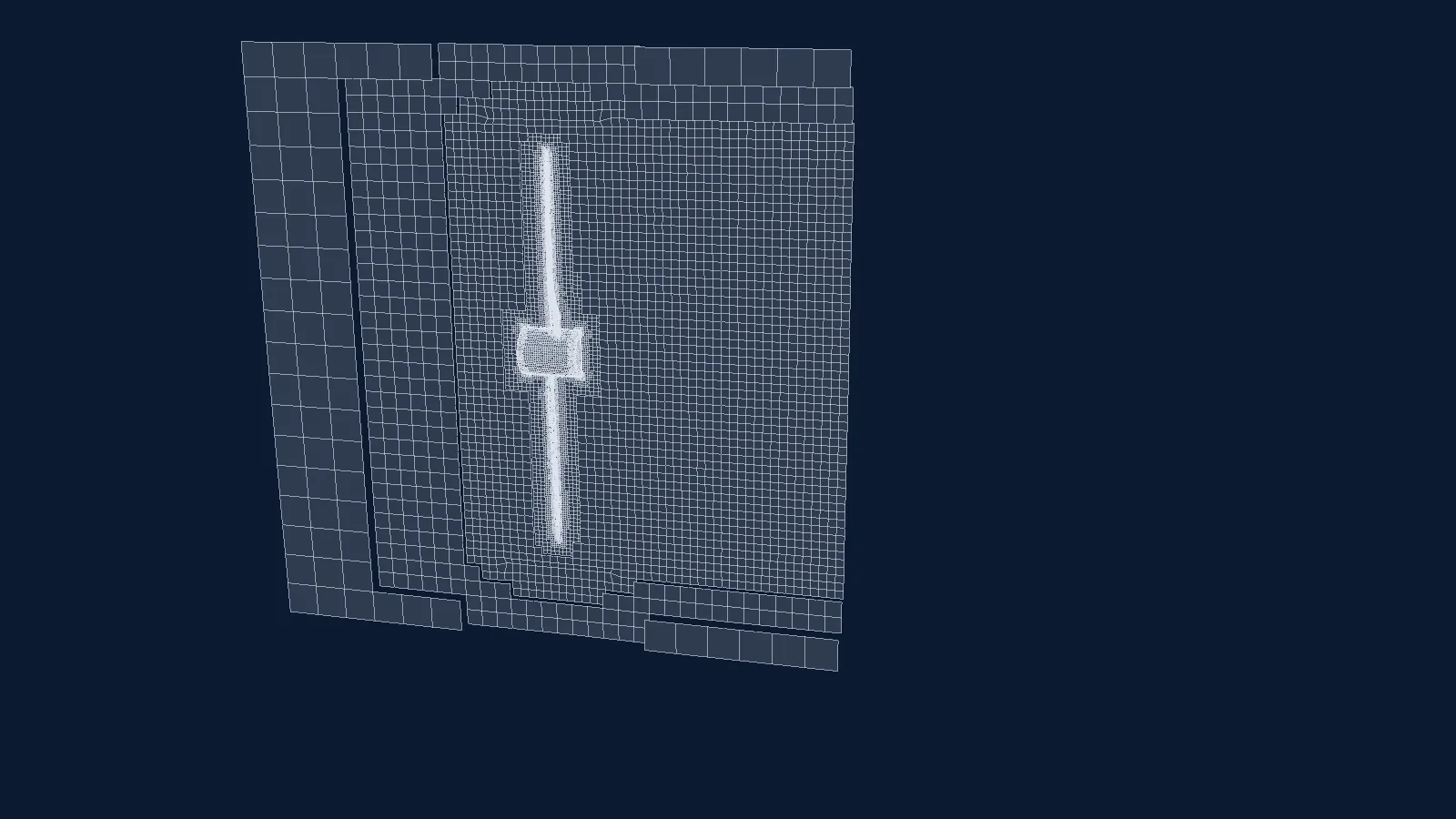
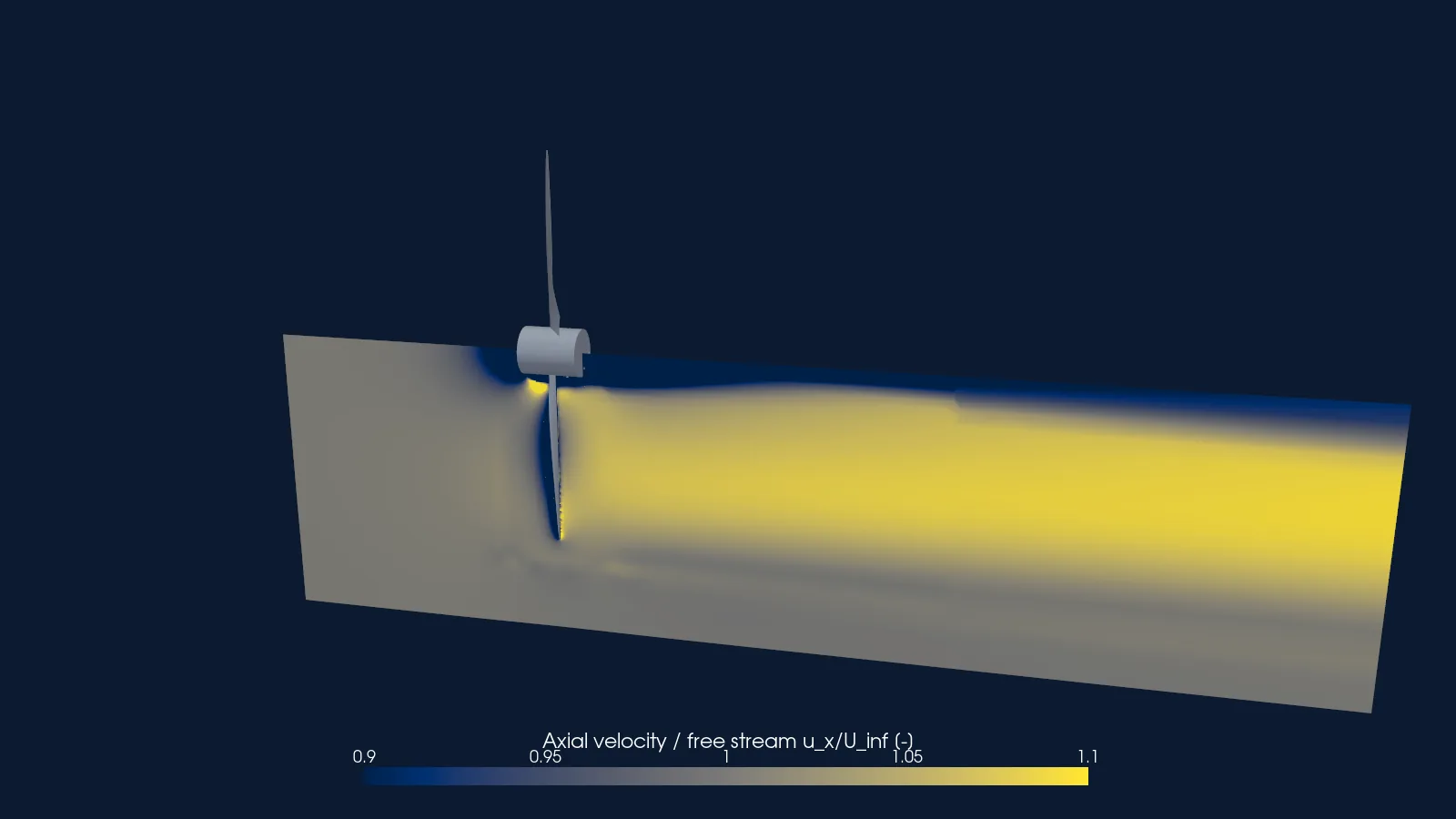
APC 11x5.5E propeller lofted from the published chord and twist table (Clark-Y sections, re-pitched to 5.5 in, estimated hub); outline of the rotating (MRF) zone and the domain box.
No poster exported for this step.
Drag to rotate, right-drag or two fingers to pan, wheel or pinch to zoom, click to read a value. Keys: arrows pan, W A S D rotate, + and − zoom, Enter reads the value at the centre.
3Case parameters
| Advance ratio J = V / (n D) | 0.523 |
|---|---|
| Rotational speed | 4998 rpm (523.389336 rad/s) |
| Diameter | 0.2794 m |
| Free-stream speed | 12.172312 m/s |
| Chord Reynolds number | 6.3 × 10⁴ at three-quarter radius, 2.0 × 10⁴ at the tip |
| Fluid | Incompressible air, kinematic viscosity 1.5e-05 m²/s (test temperature not published), density 1.225 kg/m³ |
| Solver | OpenFOAM v2412, simpleFoam (SIMPLEC) with a multiple-reference-frame rotor zone |
| Turbulence model | k-omega SST, fully turbulent |
| Wall treatment | Spalding wall function (nutUSpaldingWallFunction); blade y+ min 0.10, mean 2.86, max 72.7 |
| Cells | 1,249,851 |
| Run cost | 1000 iterations on 6 MPI ranks, 6477 s wall clock |
4Experiment
The reference is the UIUC propeller database (volume 1), APC 11x5.5E, run kt0470 at 4998 rpm. The values are tabulated in text files, not digitised. At J 0.523 the table gives CT 0.0156, CP 0.0152 and efficiency 0.535; J 0.523 is an exact row, so no interpolation is needed. The same database gives the blade chord and twist table I lofted the blade from.
UIUC corrects its free-stream speed for tunnel blockage, wall effects and pitot inflow, so a free-air domain is the right comparison. The rig has a motor housing and fairing behind the propeller; my model has none.
The operating point sits on the steep part of the thrust curve: from the neighbouring UIUC rows, a 1 % change in J moves CT by about 5.4 %. A thrust match at this point therefore says little about precision unless the tunnel speed, rotational speed and density are known to well under 1 %, and UIUC does not publish that uncertainty.
| Stated uncertainty | Not stated in the source: UIUC does not publish an uncertainty for CT or CP. The table columns are rounded to four decimals. |
|---|---|
| Blockage and corrections | Applied by UIUC to the free-stream speed (blockage, wall effects, pitot inflow); none applied by me. |
| Licence | Licence not stated locally: no licence file in the UIUC archive. Attributed to Brandt (2005) and Brandt and Selig (2011), as the database asks. |
Thrust coefficient against advance ratio (UIUC propDB, kt0470, 4998 rpm), with the two simulations
Experimental values (8 points)
| Advance ratio J | UIUC propDB (kt0470, 4998 rpm) |
|---|---|
| 0.447 | 0.0277 |
| 0.471 | 0.024 |
| 0.498 | 0.0197 |
| 0.523 | 0.0156 |
| 0.551 | 0.0111 |
| 0.576 | 0.0069 |
| 0.602 | 0.0024 |
| 0.628 | -0.0022 |
Power coefficient against advance ratio (UIUC propDB, kt0470, 4998 rpm), with the two simulations
Experimental values (8 points)
| Advance ratio J | UIUC propDB (kt0470, 4998 rpm) |
|---|---|
| 0.447 | 0.0202 |
| 0.471 | 0.0188 |
| 0.498 | 0.0169 |
| 0.523 | 0.0152 |
| 0.551 | 0.0132 |
| 0.576 | 0.0112 |
| 0.602 | 0.009 |
| 0.628 | 0.0067 |
5Set-up
Geometry, scripted from the UIUC chord and twist table: a Clark-Y section at every station, stacked on a straight radial line at quarter chord, and a capped-cylinder hub. All three are approximations I chose: APC blends a different section inboard and publishes neither its section blend nor its stacking, and the hub is an estimate.
Free-air box, x from −5D to +10D, y and z ±5D. The rotor sits in a cylindrical zone (1.15D diameter, 0.3D thick) that rotates in a moving reference frame; outside it the frame is fixed. This is a steady model, so there is no blade-passing unsteadiness.
Two lofts were solved on otherwise identical set-ups. The first follows the twist table as published, which implies 5.80 in of pitch at three-quarter radius. The second rescales tan β by 0.9486 at every station to the nominal 5.5 in. The rescale uses the propeller's name, not the thrust, but it means the blade now departs from the published table by about 5 %.
| Boundary | Type | Value |
|---|---|---|
| Inlet | fixed velocity; zero-gradient pressure; fixed k and omega | 12.172312 m/s; k 0.000222248 m²/s², omega 14.8165 1/s (turbulence intensity 0.1 %) |
| Outlet | fixed pressure; inletOutlet for U, k, omega | p 0 (kinematic) |
| Lateral faces | slip; zero gradient for p, k, omega | |
| Blades, hub | no-slip in the rotating frame; nutUSpaldingWallFunction, kqRWallFunction, blended omegaWallFunction | rotation 523.389336 rad/s about the x axis |
Numerics and convergence
Steady simpleFoam, SIMPLEC, 1000 iterations with no residual control. Thrust and torque are means over the last 500 iterations.
Iterative uncertainty, taken as the larger of the drift over the last 500 iterations and the standard deviation, is 0.01 % for thrust and for torque. That is iteration error only; there is no grid study.
6Mesh
| Cells | 1,249,851 |
|---|---|
| Blade surface cell size | 0.36 to 0.73 mm |
| Prism layers achieved | 10.7 of 15 on the blades, 11.8 of 15 on the hub (15 requested) |
| Blade y+ | min 0.10, mean 2.86, max 72.7 (design target 0.68) |
| Hub y+ | max 10.6, mean 0.74 |
| Max non-orthogonality | 74.87 |
| Max skewness | 5.31 (2 blade faces above the limit of 4) |
| Max aspect ratio | 278 |
| checkMesh verdict | “Max skewness = 5.3096891, 2 highly skew faces detected which may impair the quality of the results”; “Failed 1 mesh checks.” |
| Waiver | Recorded in MESH-WAIVER.txt: “WAIVED 2026-09-23 by founder in session”; the effect of the two faces was never tested |
One grid. The mesh fails one checkMesh test: 2 blade faces with skewness 5.31, above the limit of 4. I waived it and solved, and the waiver is on file; I never ran a mesh with those faces fixed, so their effect on the forces is unknown.
The near-wall mesh is not what I designed. Over the front half of the chord the first cell is at the design 3.2 µm, but aft of about three quarters chord it grows to 16 to 107 µm, and the blade y+ reaches 72.7 where the design was below 1. Changing the layer limiter (maxThicknessToMedialRatio 0.3 to 1.0) changed nothing, and after two trials the cause is still open.
7Results
With the blade re-pitched to the nominal 5.5 in: CT 0.01558, integrated over blades and hub, against 0.0156 (−0.11 %), CP 0.01696 against 0.0152 (+11.6 %), efficiency 0.481 against 0.535 (−10.2 %). One grid, no numerical uncertainty.
Data tables, one per series (8 points, 1 point, 1 point)
| Advance ratio J | UIUC propDB (kt0470, 4998 rpm) |
|---|---|
| 0.447 | 0.0277 |
| 0.471 | 0.024 |
| 0.498 | 0.0197 |
| 0.523 | 0.0156 |
| 0.551 | 0.0111 |
| 0.576 | 0.0069 |
| 0.602 | 0.0024 |
| 0.628 | -0.0022 |
| Advance ratio J | Simulation, re-pitched to 5.5 in |
|---|---|
| 0.523 | 0.01558 |
| Advance ratio J | Simulation, table loft (5.80 in) |
|---|---|
| 0.523 | 0.01994 |
Data tables, one per series (8 points, 1 point, 1 point)
| Advance ratio J | UIUC propDB (kt0470, 4998 rpm) |
|---|---|
| 0.447 | 0.0202 |
| 0.471 | 0.0188 |
| 0.498 | 0.0169 |
| 0.523 | 0.0152 |
| 0.551 | 0.0132 |
| 0.576 | 0.0112 |
| 0.602 | 0.009 |
| 0.628 | 0.0067 |
| Advance ratio J | Simulation, re-pitched to 5.5 in |
|---|---|
| 0.523 | 0.01696 |
| Advance ratio J | Simulation, table loft (5.80 in) |
|---|---|
| 0.523 | 0.01932 |
| Quantity | Experiment | Simulation | Signed difference |
|---|---|---|---|
| CT, re-pitched to 5.5 in (blades and hub) | 0.0156 | 0.01558 | −0.11 % |
| CP, re-pitched to 5.5 in (blades and hub) | 0.0152 | 0.01696 | +11.6 % |
| Efficiency, re-pitched to 5.5 in | 0.535 | 0.481 | −10.2 % |
| CT, re-pitched, blades only (no hub) | 0.0156 | 0.01686 | +8.1 % |
| CT, table loft 5.80 in | 0.0156 | 0.01994 | +27.8 % |
| CP, table loft 5.80 in | 0.0152 | 0.01932 | +27.1 % |
| Efficiency, table loft 5.80 in | 0.535 | 0.540 | +0.9 % |
The diagnosis. With the table loft, thrust and power were both high by about the same factor (+27.8 % and +27.1 %) while efficiency was close (+0.9 %). That is the signature of a blade with too much pitch, not of a physics error, and the table does imply 5.80 in against the nominal 5.5 in. Re-pitching removed the thrust error.
The thrust match is not a precision number. At this J, a 1 % change in J moves CT by about 5.4 %; UIUC does not publish its uncertainty; the blade pitch itself is uncertain between 5.5 in and the 5.80 in of the table; and the blades alone give CT 0.01686 (+8.1 %), so the whole-body figure leans on the estimated hub, which adds 0.066 N of drag.
Power is +11.6 % high and I do not know why. Two hypotheses, neither confirmed: the coarse near-wall cells aft on the chord, and low-Reynolds-number physics (chord Reynolds number 6.3 × 10⁴ at three-quarter radius, where a fully turbulent model over-predicts skin friction). Testing the second needs a transition model, which needs y+ below 1 everywhere, so it is blocked on the first. The case is parked.
8Numerical accuracy
None: single grid. No grid-convergence study was run, so there is no numerical uncertainty on any number above. The only quantified error is iterative (0.01 %), which excludes the grid, the waived faces and the near-wall resolution.
9Why they differ, and what I distrust
Limits, as recorded in the ledger. The thrust match is not a precision claim: at J 0.523 a 1 % change in J moves CT by about 5 %, UIUC's uncertainty is unpublished, and the hub is estimated (blades-only CT +8 %). The loft departs 5 % from the published twist table. checkMesh failed on 2 blade faces (waived, recorded); about 11 of 15 layers achieved; blade y+ max 72.7; aft-chord first cells 16-107 um, unexplained after two trials. Power +11.6 % is unexplained and parked. 1000 iterations, single grid, no GCI.
- The geometry: Clark-Y everywhere, straight stacking and an estimated hub, plus a deliberate re-pitch of about 5 % away from the published twist table. The whole-body thrust match depends on the hub estimate.
- The thrust agreement itself: on this steep part of the curve, 1 % in J is 5.4 % in CT, and UIUC's uncertainty is unpublished.
- The near-wall mesh aft on the chord, which I could not fix, and blade y+ up to 72.7 on a mesh designed for y+ below 1.
- Two skewed blade faces, waived, effect untested. Only 10.7 of 15 requested prism layers were achieved on the blades.
- Fully turbulent SST at a chord Reynolds number of 6.3 × 10⁴, where the real boundary layer is probably laminar or transitional. This is my leading suspect for the power excess, untested.
- Steady MRF, one operating point, 1000 iterations, no motor or fairing, and air viscosity assumed because the test temperature is not published.
10References
- J. B. Brandt and M. S. Selig (2011), “Propeller Performance Data at Low Reynolds Numbers”, 49th AIAA Aerospace Sciences Meeting, AIAA Paper 2011-1255, Orlando, FL. https://m-selig.ae.illinois.edu/pubs/BrandtSelig-2011-AIAA-2011-1255-LRN-Propellers.pdf
- J. B. Brandt (2005), “Small-Scale Propeller Performance at Low Speeds”, M.S. thesis, Department of Aerospace Engineering, University of Illinois at Urbana-Champaign.
- UIUC Propeller Data Site, volume 1: APC 11x5.5E, run kt0470 at 4998 rpm (apce_11x5.5_kt0470_4998.txt) and chord and twist table (apce_11x5.5_geom.txt).
Source files
D:/CFD/propeller/CASE-STUDY.mdD:/CFD/propeller/README.mdD:/CFD/propeller/j0523_p55/RESULT.txtD:/CFD/propeller/j0523/RESULT.txtD:/CFD/propeller/j0523_p55/log.checkMeshD:/CFD/propeller/j0523_p55/MESH-WAIVER.txtD:/CFD/propeller/j0523_p55/log.simpleFoamD:/CFD/propeller/j0523_p55/postProcessing/yPlus/0/yPlus.datD:/CFD/propeller/j0523_p55/meta.json, 0.orig/, constant/, system/D:/CFD/propeller/j0523_p55_m1/TRIAL.txtD:/CFD/data/propeller/uiuc-apc/extracted/UIUC-propDB/volume-1/data/apce_11x5.5_kt0470_4998.txtD:/CFD/data/propeller/uiuc-apc/SOURCE.mdinvestigation/lane-D-propeller-cylinder.md and EVALUATION-fable.md (evidence audit and evaluation)pipeline/case_data/propeller-apc-11x55.py (chart data)
Last updated 2026-11-14. One-page summary (prints to one A4 page), also as a PDF. Every number on this page is checked against its source file by pipeline/check_numbers.py.